Table of Contents
- Why Exterior Paint Choice Matters in North Texas
- Signs Your Home Needs a New Exterior Paint Job
- Top Exterior Paint Brands for North Texas Conditions
- How to Prepare Home Exterior for Painting
- Climate-Specific Paint Features for North Texas
- Cost of Professional Exterior Painting
- DIY vs. Professional Application: What You Should Know
- Maintenance After Your Exterior Paint Job
- Frequently Asked Questions
Last Updated: October 9, 2026
Why Exterior Paint Choice Matters in North Texas
Choosing the best exterior paint for north in Texas is critical for long-term durability and curb appeal. Intense summer heat, ice storms, high humidity, and intense UV exposure all work against your exterior finish, so a paint that works in cooler climates will fail here within months.
The wrong paint peels, chalks, and fades within 18 months; the right paint maintains color, adhesion, and its protective barrier for five years or longer, even in extreme conditions.
A failed paint job costs you twice: once for the failed application, and again when you repaint sooner than expected. A deteriorating exterior also signals neglect to potential buyers. Proper paint selection plus meticulous surface preparation protects your investment and your curb appeal.
Signs Your Home Needs a New Exterior Paint Job
Your home signals it needs new paint before failure becomes severe. Watch for these warning signs.
Chalking is one of the earliest signals. Run your hand over the surface; white powder on your fingers means the paint’s binder is breaking down, accelerated here by UV exposure.
Peeling and blistering mean moisture is trapped beneath the paint, usually from inadequate prep or a primer that didn’t bond.
Fading and color shift mean pigments are breaking down under UV exposure.
Mildew and mold growth on shaded areas or trim means the paint lacks adequate moisture resistance, especially on north-facing walls that stay damp longer.
If you’re seeing any of these, the exterior paint job has already failed. The sooner you address it, the less substrate damage you’ll have to repair underneath.
Top Exterior Paint Brands for North Texas Conditions
Not all exterior paints perform equally here.
PPG Permanizer: Best Overall Performance
PPG Permanizer ranks first in durability testing, delivering exceptional adhesion and better color retention than most competitors under prolonged UV exposure.
The formula resists chalking, peeling, and moisture penetration better than budget alternatives, applies smoothly, levels well, and creates a hard finish that stands up to thermal expansion without cracking.
What works: Superior adhesion to most substrates, excellent UV resistance, strong mildew protection, and a finish that maintains sheen retention over time.
What doesn’t: It’s priced at the premium end, but the extended lifespan typically justifies the investment.
PPG Permanizer performs exceptionally well on wood siding and masonry. If your home has mixed substrate types, this paint handles the transition better than single-purpose formulations.
Behr Pro e600: Cost-Effective Durability
Behr Pro e600 ranks second in performance testing and costs noticeably less than premium alternatives, delivering solid results for homeowners balancing budget with durability.
The acrylic latex formulation resists moisture and UV fading, bonds strongly to prepared surfaces, maintains adhesion through temperature swings, and applies easily, making it popular with professional painters.
What works: Excellent value for the price, good adhesion, adequate UV protection, and reliable performance on most residential substrates.
What doesn’t: It doesn’t match PPG Permanizer’s sheen retention or chalking resistance over five-plus years, so if you’re staying a decade or longer, the premium option pays for itself.
Budget-conscious homeowners who want reliable performance without premium pricing, or those planning to repaint every 4-5 years anyway.
Sherwin-Williams SuperPaint Exterior: Reliable Choice
Sherwin-Williams SuperPaint Exterior is a trusted workhorse that performs consistently across North Texas conditions, not the absolute best in any category, but excellent across all metrics.
It provides strong adhesion, good moisture resistance, and reasonable UV protection, handling temperature extremes without excessive cracking or peeling and maintaining acceptable color retention.
What works: Consistent performance, good adhesion, available everywhere, and reliable customer service from Sherwin-Williams retailers.
What doesn’t: It costs more than Behr Pro e600 without outperforming it enough to justify the difference for most homeowners.
Behr Marquee and Sherwin-Williams Emerald: Premium Options
Behr Marquee and Sherwin-Williams Emerald occupy the premium tier alongside PPG Permanizer, with excellent performance, strong adhesion, and superior color retention.
Behr Marquee emphasizes moisture barrier properties and mildew resistance for shaded areas or humid microclimates; Sherwin-Williams Emerald focuses on durability, UV protection, and exceptional color fastness.
What works: Both resist chalking, peeling, and fading comparably to PPG Permanizer, handle thermal expansion without cracking, and maintain adhesion through freeze-thaw cycles.
What doesn’t: Both are priced at the top of the market; unless your home has specific moisture or UV challenges, mid-tier options perform adequately.
| Paint Brand | Performance Tier | Best For | Key Strength |
|---|---|---|---|
| PPG Permanizer | Premium | Long-term durability | Adhesion & UV resistance |
| Behr Pro e600 | Mid-range | Budget-conscious buyers | Value for price |
| Sherwin-Williams SuperPaint | Mid-range | Reliable performance | Consistent results |
| Behr Marquee | Premium | Humid climates | Moisture barrier |
| Sherwin-Williams Emerald | Premium | Color retention | Fade resistance |
How to Prepare Home Exterior for Painting
Surface preparation determines whether your new paint lasts five years or fails within eighteen months. It’s where most DIY projects fail and the single most important factor in paint longevity.
Surface Inspection and Cleaning
Before any paint touches the substrate, walk the entire exterior and document existing damage: peeling paint, chalking, mildew, water stains, cracks, and exposed substrate.
Cleaning is non-negotiable. Power wash the exterior at moderate pressure (1500-2000 PSI) to remove dirt, mold, mildew, and chalked paint without damaging wood siding or masonry mortar, then allow 48 hours of dry weather before proceeding.
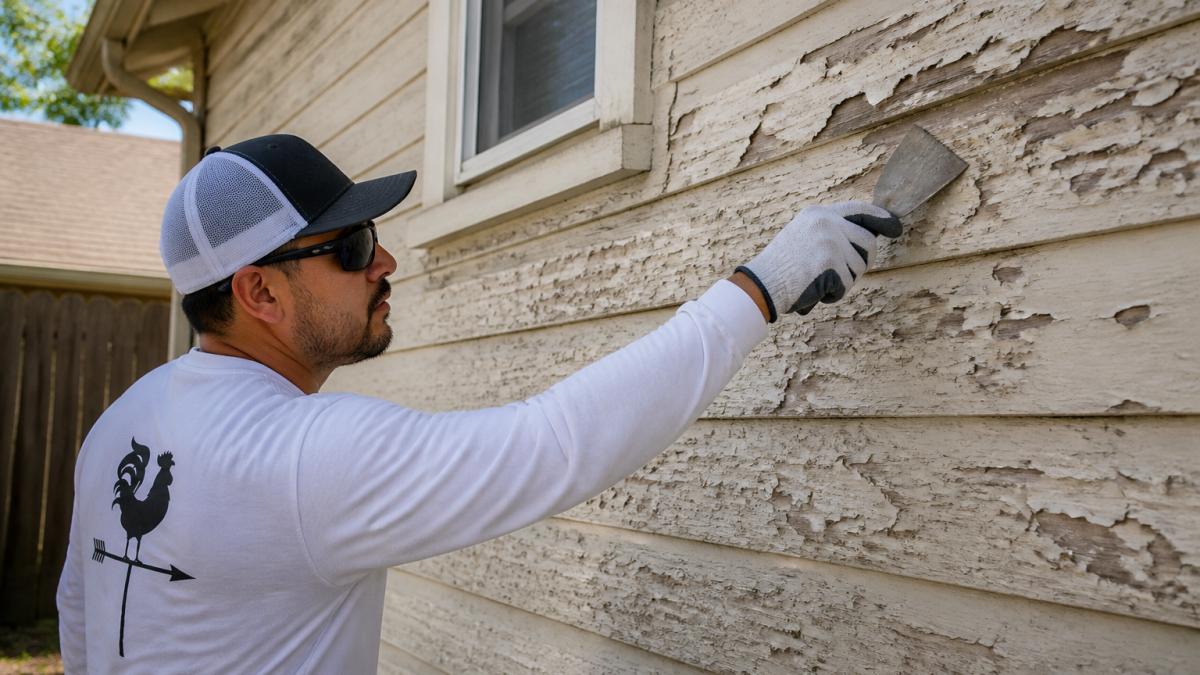
Chalk test: After cleaning, rub a dark cloth over a painted area. White powder means chalking is present, and chalked surfaces must be stripped or sanded to bare substrate or new paint won’t adhere.
Mildew treatment: If mold or mildew is present, treat it with a mildicide solution before painting. Paint alone won’t stop mildew from returning; you must kill the organisms first.
Click here to Schedule Free Quote →
Repair and Primer Application
Once the surface is clean and dry, fill cracks with caulk, patch gouges with wood filler, and repair rotted wood before it spreads.
Primer selection matters as much as paint selection. Use alkyd primer on wood siding (it penetrates wood fibers for superior adhesion) and latex primer on porous masonry. Never skip primer on bare substrate.
Let primer cure fully (typically 24 hours) before the finish coat. One coat is rarely enough; two coats on bare wood ensure adhesion and prevent bleed-through.
Climate-Specific Paint Features for North Texas
The best exterior paint for north in Texas is formulated for its specific combination of heat, humidity, and UV intensity; generic exterior paint fails here.
Heat-reflective properties reduce surface temperature on dark exteriors, minimizing thermal expansion stress. Dark paint in 100°F heat can exceed 150°F surface temperature, stressing the film and causing cracks; reflective pigments reduce this.
Moisture barriers are essential because humidity lingers here. Paint that allows vapor transmission traps moisture beneath the film, causing peeling and blistering, look for high-humidity ratings.
UV-resistant formulations use pigments and resins engineered to resist fading. North Texas gets 220+ days of sunshine annually; paint that works in Seattle fades noticeably here within two years.
Mildew-resistant additives prevent fungal growth on shaded areas and north-facing walls, especially if trees keep certain areas perpetually damp.
Flexibility and adhesion prevent cracking during dramatic temperature swings. Paint that’s too rigid fails as the substrate expands and contracts; quality exterior paints flex slightly without losing integrity.
Cheap exterior paint skimps on these formulation elements. It looks fine for the first year, then chalks, fades, and peels because it wasn’t engineered for our specific climate. The savings upfront cost you double when you repaint two years early.
Cost of Professional Exterior Painting
Professional exterior painting costs depend on home size, substrate type, existing paint condition, and whether repairs are needed.
Rather than guess at pricing, get detailed written estimates from multiple painters. Pricing varies with local labor costs, materials, and prep scope, what matters is understanding what you’re paying for.
Quality painters charge more because they do better prep work. If a quote seems unusually low, ask what surface preparation is included, sanding, scraping, caulking, substrate repair. The cheapest quote often skips these steps, which is why the paint fails early.
Material costs vary by brand. PPG Permanizer costs more per gallon than Behr Pro e600, but its extended lifespan means fewer repaint cycles. Calculate cost per year of durability, not upfront price.
At Rooster Painting, we provide free detailed written estimates spelling out materials, labor, prep work, and timeline.
DIY vs. Professional Application: What You Should Know
The temptation to paint your own exterior is understandable, but professional application isn’t just about speed, it’s technique, equipment, and experience that directly affect paint longevity.
Surface preparation is where most DIY projects fail. Professionals spend 60-70% of project time on prep, power washing, scraping, sanding, caulking, priming, while DIY painters rush it to get to the visible painting, guaranteeing early failure.
Equipment matters. Professionals use airless sprayers for even, efficient coverage; brush-and-roller DIY work leaves lap marks, uneven coverage, and inconsistent sheen. Spray equipment costs $1,000+, which is why homeowners resort to inferior methods.
Weather windows are critical. Paint must be applied within specific temperature and humidity ranges or it won’t cure properly. Professionals monitor forecasts and schedule accordingly; DIY painters often paint anyway.
Safety is real. Multi-story exteriors require scaffolding or lifts; DIY painters on ladders face fall risks that professionals mitigate with proper equipment and training.
A failed DIY paint job costs you the materials, your time, and then the full cost of professional repainting to fix it. The math rarely works in favor of DIY on exterior projects.
Maintenance After Your Exterior Paint Job
Your new paint job isn’t maintenance-free. Simple steps extend its lifespan.
Annual inspection catches problems early. Walk the exterior each spring for adhesion loss, chalking, or moisture issues, and address small problems before they spread.
Clean gutters and downspouts so water doesn’t run down the siding; stagnant moisture accelerates failure, particularly on north-facing walls.
Caulk gaps and cracks as they appear, cheaper than repainting and it prevents water infiltration that damages the substrate.
Power wash every 2-3 years to remove dirt, mildew, and chalked paint particles that trap moisture against the substrate.
Trim overhanging branches to increase airflow and reduce moisture retention on shaded areas, so surfaces dry faster after rain.
Choosing exterior paint that works best for North Texas means matching your climate’s challenges with paint engineered to handle them. PPG Permanizer delivers the best overall performance, while Behr Pro e600 offers solid durability at a lower price.
At Rooster Painting, we specialize in exterior transformations that last. We provide a worry-free warranty and clear communication throughout the project, so you know exactly what to expect. Click here to Schedule Free Quote and get a detailed written estimate with no obligation.
Frequently Asked Questions
What type of exterior paint is best for high heat and humidity in North Texas?
Acrylic latex paints with UV-protective additives and mildew resistance perform best in North Texas conditions. Look for products that offer heat-reflective properties and strong moisture barriers. Brands like PPG Permanizer and Sherwin-Williams SuperPaint Exterior are formulated to withstand thermal expansion from extreme heat and resist chalking and fading. Proper surface preparation and primer application ensure the paint adheres well despite humidity fluctuations.
How often should you repaint your home exterior in this region?
Most homes in North Texas need repainting every 5-7 years due to intense UV exposure and temperature swings. However, this depends on paint quality, surface condition, and maintenance. High-end products like Sherwin-Williams Emerald may last longer, while budget options may fade faster. Regular inspection for chalking, peeling, or color fading helps determine when repainting is needed. Professional painters can assess your current paint’s condition during a free consultation.
How does how to prepare home exterior for painting affect the final result?
Surface preparation is critical, it directly determines paint adhesion and longevity. Skipping this step causes peeling, blistering, and premature failure within 1-2 years. Proper preparation includes cleaning, scraping loose paint, repairing cracks and wood rot, and applying primer. These steps ensure the new paint bonds correctly despite North Texas heat and humidity. Professional painters invest significant time in preparation, which is why their work lasts longer than DIY attempts that rush this phase.
What sheen finish should I choose for exterior siding in North Texas?
Satin finish is typically the best choice for exterior siding in this climate. It provides a subtle sheen that resists dirt and moisture while hiding surface imperfections better than gloss. Flat finishes may look dull in direct sunlight and don’t clean as easily. Semi-gloss works well for trim and doors. The right sheen improves sheen retention over time and makes maintenance easier in high-humidity conditions.