
Last Updated: November 4, 2026
Quick Summary
Popcorn ceiling removal costs vary widely because contractors scope the job differently, so there is no single fixed rate. Pricing depends on room size, ceiling height, surface condition, needed repairs, and whether asbestos testing is required. Request a written, room-by-room quote to compare bids fairly.
- Ceiling height and access raise labor because high or vaulted ceilings need lifts or scaffolding.
- Homes built before the late 1980s may contain asbestos, so test the texture before disturbing it.
- Asbestos testing is a separate line item, and detected asbestos requires licensed abatement.
- Ask each contractor to break quotes down by room and by square foot for fair comparison.
- DIY suits only one small room with tested, non-asbestos texture and standard-height ceilings.
Table of Contents
- What Popcorn Ceiling Removal Typically Involves
- Popcorn Ceiling Removal Cost Calculator: How to Estimate Your Project
- Popcorn Ceiling Removal Cost per Room and per Square Foot
- Factors That Change Your Removal Quote
- Popcorn Ceiling Removal vs. Covering Cost
- Popcorn Ceiling Asbestos Testing Cost and When to Test
- Can You Remove Popcorn Ceiling Yourself, and What Does It Really Cost?
- Get a Free, Itemized Quote for Your Ceiling Project
- Frequently Asked Questions
How much does popcorn ceiling removal cost in 2026? Most homeowners in North Texas who ask this question get wildly different quotes, and the spread usually has less to do with the ceiling than with how each contractor scoped the job. This guide breaks down what typically drives the price of popcorn ceiling removal.
What Popcorn Ceiling Removal Typically Involves
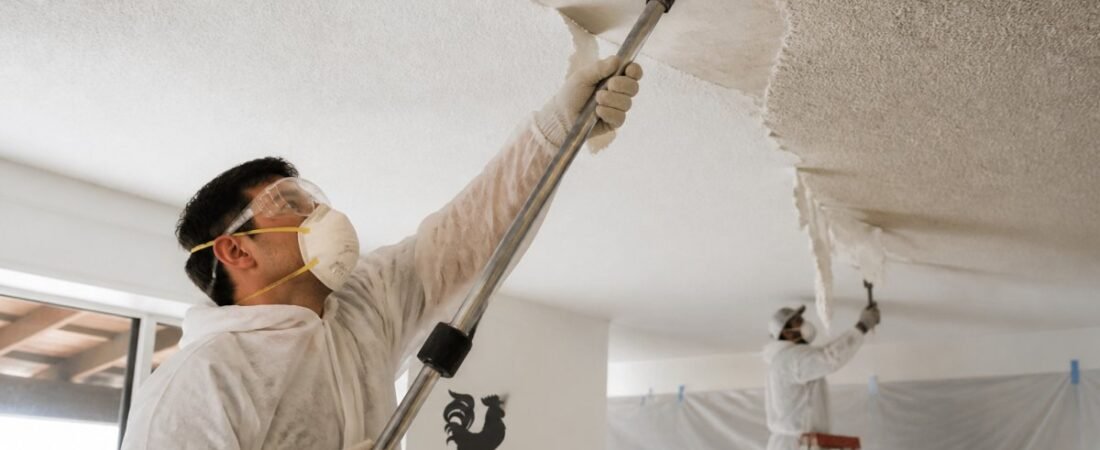
Popcorn ceiling removal is the process of softening the sprayed texture, scraping it off, and then repairing and repainting the ceiling underneath.
A typical job includes:
- Covering floors, walls, and furniture with plastic and drop cloths
- Testing the texture for asbestos before any disturbance
- Misting or wetting small sections so the texture softens
- Scraping the texture off and bagging the debris
- Patching cracks, nail holes, and damaged drywall
- Applying a skim coat or primer, then painting
Popcorn Ceiling Removal Cost Calculator: How to Estimate Your Project
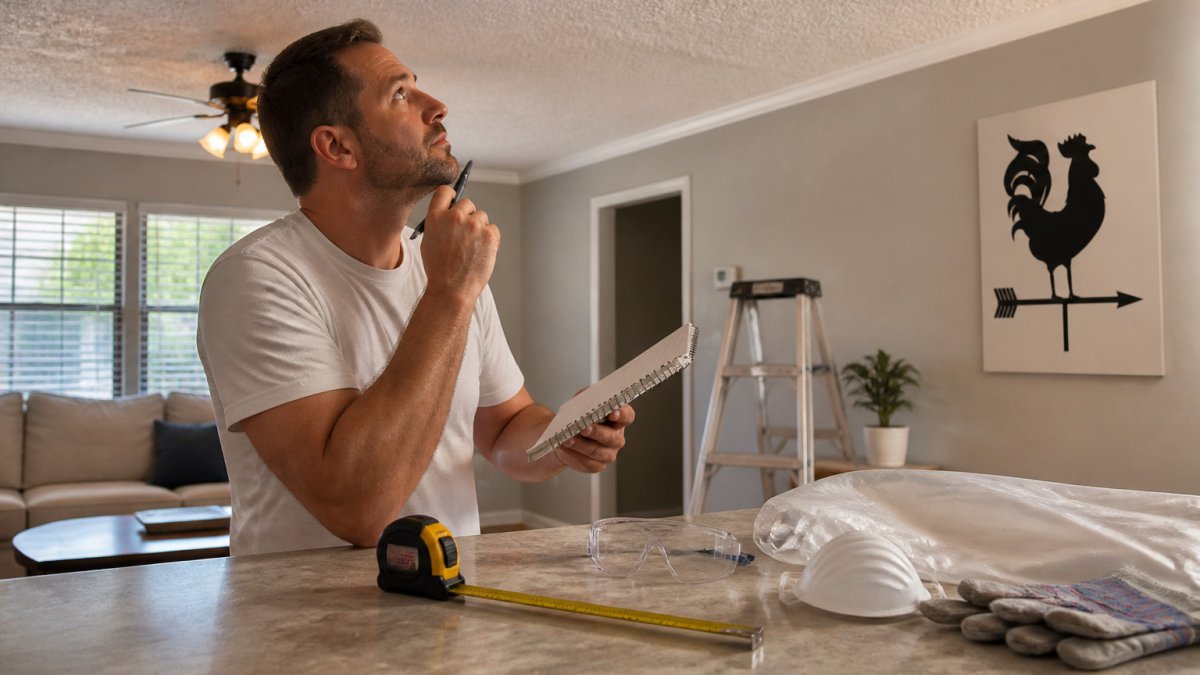
You can get a rough estimate yourself before calling anyone. Start by measuring the length and width of each room, then multiply to get the square footage. Add the square footage for every ceiling you plan to remove.
Then apply a simple checklist:
- Room size: Larger rooms take more time per square foot.
- Ceiling height: Vaulted or high ceilings need lifts or scaffolding, which raises labor.
- Number of rooms: Multiple rooms often lower the per-room cost through efficiency.
- Repairs needed: Water stains or damaged drywall add time.
- Testing: Asbestos testing is a separate line item.
This gives you a worksheet to compare against written quotes.
Popcorn Ceiling Removal Cost per Room and per Square Foot
Pricing depends on the size of the ceiling, the condition of the surface, access, and how much repair work is needed, so we do not publish a fixed rate here.
To compare bids fairly, ask each contractor to break their quote down by room and by square foot. A written, room-by-room quote makes it easy to see where the money goes and to spot gaps. Rooster Painting provides free, itemized written estimates, which you can request through the contact page.
Factors That Change Your Removal Quote
Several conditions move the price up or down:
- Ceiling height and access: High or vaulted ceilings need extra equipment.
- Surface condition: Flaking texture or water damage takes longer to clean.
- Repairs: Cracks, holes, and damaged drywall need patching before paint.
- Furniture and room clearing: Heavily furnished rooms take more time to protect.
- Finish quality: A smooth skim coat costs more than a basic flat finish.
Asbestos Testing and Abatement
Homes built before the late 1980s may have asbestos in popcorn texture. Federal rules from the U.S. Environmental Protection Agency govern how asbestos is handled, and state rules in Texas apply as well. Testing a small sample before work begins tells you whether special handling is needed. For a closely related job, the interior house painting cost guide walks through how to estimate painting costs in more depth.
If asbestos is found, removal requires licensed abatement, which adds significant cost. Do not disturb suspect texture until it has been tested. The [U.S. Environmental Protection Agency asbestos guidance | epa.gov] explains the basic steps homeowners should know.
Popcorn Ceiling Removal vs. Covering Cost
Some homeowners consider covering the texture instead of removing it. Options include a thin skim coat over the existing surface or a new drywall layer. Covering often costs less up front, but it adds weight, hides the ceiling height, and may not suit every surface.
Removal gives a smoother result and fixes problems hidden under the texture. Covering is usually the better choice when the texture is sound and asbestos is present. Weigh both options against the ceiling’s condition and your plans for the room.
Popcorn Ceiling Asbestos Testing Cost and When to Test
Asbestos testing is the single decision that can change a popcorn ceiling project from a weekend scrape into a regulated abatement job. Treat it as step one, not an upsell.
When testing is warranted. The U.S. Environmental Protection Agency advises that homes built before the late 1980s may contain asbestos in sprayed-on ceiling texture. A common pattern is to test any texture in a home built before 1990, and to test regardless of age if the texture is friable, crumbling, flaking, or easily crumbled by hand, because friable material releases fibers more readily. If you do not know the build year, test.
How sampling works. A proper sample is a small chunk of texture plus a bit of the underlying joint compound, taken from more than one location because asbestos is not always evenly distributed. The person taking the sample should wet the area, wear a respirator rated for fine particulates, seal the sample in a labeled bag, and patch the spot.
Click here to Schedule Free Quote →
What lab testing costs. Lab analysis is priced per sample, not per square foot, and the price depends on the lab and the turnaround time. Ask the lab whether it uses polarized light microscopy (the standard method for bulk samples) and get the fee in writing before you ship anything. Because prices vary by lab and region, request a current quote rather than relying on a number from an article.
Reading the result and choosing a path.
- No asbestos detected: Proceed with removal using normal dust controls, plastic containment, wet methods, HEPA vacuuming, and bagged debris.
- Asbestos detected, texture intact and undisturbed: You are not required to remove it. Encapsulation, covering with new drywall, or leaving it alone are all legitimate options. Disturbing it is what creates risk.
- Asbestos detected and removal is the goal: Removal must be performed by a licensed abatement contractor under applicable federal and state rules, with containment, negative air pressure, and regulated waste disposal. This is a separate, higher-cost scope than standard scraping.
Stop-work guidance. If texture starts crumbling during a scrape and you have not tested, stop. Do not vacuum it with a shop vac, do not sweep it dry, and do not run fans. Mist the area, seal the room, and call for testing.
Who regulates it. Federal rules from the U.S. Environmental Protection Agency govern how asbestos is handled in homes and during renovation, and state rules apply on top of them (the EPA). The [U.S. Environmental Protection Agency asbestos guidance | epa.gov] explains sampling, abatement, and disposal requirements homeowners should know before work begins.
Asbestos testing comes first, and the article’s guidance on when to test and what to do with the result breaks down as follows.
| Test result | What to do |
|---|---|
| No asbestos detected | Remove using normal dust controls |
| Asbestos, texture intact | Encapsulate, cover, or leave alone |
| Asbestos, removal planned | Hire a licensed abatement contractor |
| Texture crumbling during scrape | Stop, mist, seal room, call for testing |
Can You Remove Popcorn Ceiling Yourself, and What Does It Really Cost?
DIY removal is realistic for a single small room with tested, non-asbestos texture and a standard-height ceiling. It is a poor fit for vaulted ceilings, large open areas, textured ceilings that have been painted over, or any ceiling where asbestos is suspected or confirmed.
What you actually need to buy or rent.
- Pump sprayer or garden sprayer for wetting sections
- Wide drywall knife or floor scraper (a 4- to 6-inch blade is a common choice)
- Plastic sheeting and painter’s tape for containment
- Drop cloths for floors and furniture
- Respirator rated for fine dust, plus eye protection
- HEPA vacuum for cleanup
- Joint compound, taping knife, and sanding sponge for patching
- Primer and ceiling paint
- Heavy-duty bags for debris
Most of these are inexpensive individually, but the total adds up once you include plastic, tape, bags, patching compound, primer, and paint. If you already own a sprayer, scraper, and respirator, your out-of-pocket cost drops sharply; if you are buying everything for one room, the tool and material total can approach the lower end of a professional quote for that same room.
The time estimate. Multiply that by the number of rooms and add drying time between coats.
The costs articles usually leave out.
- Disposal: Scraped texture is bulky and heavy. Bagging it and hauling it to a transfer station usually carries a fee, and some jurisdictions restrict how it must be bagged.
- Repairs: Scraping frequently nicks drywall paper or exposes seams. Patching and skim coating are the steps most likely to blow a DIY timeline.
- Redo risk: A poor scrape job shows up as gouges and uneven paint. Fixing it professionally costs more than starting professionally.
- Your time: The labor is physical, overhead work, and messy. Price your own hours honestly against what a crew would charge.
When DIY is the wrong call. Skip DIY if the texture is friable, if the home was built before the late 1980s and has not been tested, if the ceiling is vaulted or above standard reach, if the texture has been painted over, or if the room contains furniture or finishes you cannot fully protect. In those cases the professional scope, containment, testing, repairs, and cleanup, is doing real work that a DIY approach tends to underestimate.
A fair comparison. Ask a contractor for an itemized quote covering containment, scraping, repairs, priming, painting, and disposal, then compare that total against your DIY materials, tool purchases, disposal fees, and time. For one small, tested room, DIY can win on cash outlay. For multiple rooms or any complicating condition, the professional quote usually closes the gap once redo risk and disposal are counted.
Get a Free, Itemized Quote for Your Ceiling Project
Every project is different, and the best way to know your cost is a written estimate for your specific home. Rooster Painting offers free, itemized written estimates. Our team is fully insured, and we offer a worry-free warranty on our work. You can also get help choosing colors through our free color consultation, and you can learn more about our interior painting services or our exterior painting services. To get started, visit our contact page and tell us about your ceiling project. You can also review our guide to getting a free painting estimate before you reach out.
Frequently Asked Questions
How much does it cost to remove a popcorn ceiling of 1,000 square feet?
Removal cost scales with ceiling area, so a 1,000-square-foot ceiling is priced by the square foot plus any fixed charges for setup, cleanup, and debris disposal. Pricing depends on access, ceiling height, condition of the existing texture, and whether testing or repairs are needed. For a current figure based on your home, request a free detailed written estimate from Rooster Painting.
Is it cheaper to remove a popcorn ceiling or cover it?
Covering a popcorn ceiling with a smooth skim coat or drywall overlay is often less disruptive, but it adds material and labor for leveling and finishing. Removal generates more debris and may require testing first, while covering usually avoids disturbing older material. The right choice depends on ceiling condition, whether the texture is sound, and the finish you want. A written estimate for both options lets you compare them on equal terms.
Does asbestos testing increase popcorn ceiling removal costs?
Yes, testing adds a cost before any removal begins, and a positive result can add abatement requirements that raise the total. Homes built before the late 1970s carry the highest likelihood of asbestos-containing texture, so testing is worth considering before disturbing the ceiling. Ask for testing and any abatement to be itemized separately so you can see exactly what each part costs.
Can I remove a popcorn ceiling myself?
Removal is physically possible for a homeowner, but it is messy, time-consuming, and carries a real risk if the texture contains asbestos. Disturbing the material without testing or proper containment can release fibers into the home. Before attempting DIY work, test the material, plan for containment, and factor in tools, protective equipment, cleanup, and the repair and repainting that follow removal.
